Community Needs Assessment
At HSRI, we help states, counties, health and human service organizations, and community partners understand what communities need, what strengths and resources they already have, and where there are opportunities for meaningful improvement.
Our system and community needs assessments–which include gaps analyses, quality improvement measures, compliance, and more–bring together data, community perspectives, and lived experience.
Assessments can take a broad look across an entire system or focus more closely on a particular population, service area, or challenge. Most importantly, we help communities move from understanding their needs to deciding what to do next.
How have our assessments been used?
Our system and community needs assessments:
- Target investments (e.g., rural health transformation grants), where they can have the greatest impact
- Build the case for additional funding and resources
- Identify gaps and inequities in services and access
- Strengthen the full behavioral health continuum of care, including the crisis continuum
- Plan for workforce and future capacity needs
- Inform policy, legislative, and advocacy priorities and requests
- Advance Olmstead and community-integration goals
- Create a community-driven roadmap and measurable priorities for systems change
And it all starts with four practical questions.
A strong needs assessment considers how the pieces of a system work together and how people actually experience that system.
We start with four practical questions:
- What does the community need?
- What strengths, resources, and services already exist?
- Where are the gaps between those needs and existing resources?
- What can the system do to the close those gaps?
These questions are central to HSRI’s approach to systems analysis.
In Ulster County, HSRI’s behavioral health system analysis examined changing community needs alongside the county’s existing services and resources to identify gaps and opportunities for improvement. The findings led to concrete recommendations that the county incorporated into its Local Services Plan, with ongoing improvements focused on access to services, rural communities, lived experience and peer support, and better use of data to guide decisions.
HSRI partnered with the University of New Hampshire Institute on Disability to assess New Hampshire’s long-term services and supports (LTSS) system, with a focus on services that help older adults and people with disabilities live independently in their communities.
Using listening sessions, focus groups, interviews, and analysis of Medicaid claims and other data sources, we identified system strengths, service gaps, and opportunities for improvement. We also mapped community partnerships across the state to identify and inventory local assets supporting the needs of older adults and people with disabilities to live independently.
Findings informed recommendations to strengthen access to services, promote equity, improve system monitoring, and support long-term planning for New Hampshire’s long-term services and support system.
What makes HSRI’s approach different?
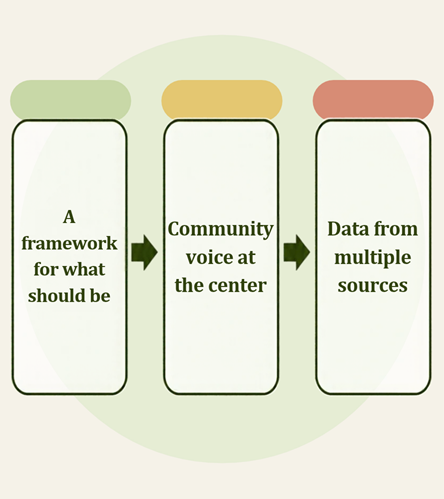
We have a framework for understanding what a strong system should look like.
To identify meaningful opportunities for change, communities need a vision for what a strong system could look like.
HSRI and partners developed the Framework for an Ideal Behavioral Health System, a set of values, expectations, and practices that describe an “ideal” system. The framework builds on the strengths your community already demonstrate. Importantly, the framework was developed with significant representation from people with lived experience using behavioral health systems.
For Forsyth County Behavioral Health Needs Assessment, HSRI used this framework alongside community input, quantitative and qualitative data, national best practices, and model systems to examine the current landscape and define a desired future state.
Our work on the North Dakota Comprehensive Behavioral Health System Analysis shows how a needs assessment can become a foundation for long-term systems change. Building on the initial analysis, HSRI has helped the state engage people with lived experience and other community partners, strengthen services and peer supports, translate priorities into concrete action steps, and establish ongoing, data-driven monitoring to support coordinated system improvement.
We truly could not be more pleased with the report. It is comprehensive, thoughtful, balanced, and provides meaningful recommendations that will help guide our work for years to come. You captured both the strengths of our behavioral health system and the opportunities ahead in a way that is constructive and actionable.
~Michael Duncan, Behavioral Health Services Director, Forsyth County Government
We put community voice and lived experience at the center.
Community engagement is an essential part of our approach, not an add-on at the end.
Depending on the project, engagement can include:
- Public community listening sessions
- Interviews
- Focus groups
- Surveys and online feedback
- Conversations with people with lived experience and families
- Engagement with providers
- Input from schools, first responders, social service organizations, and other community partners
In Multnomah County Mental Health System Analysis, HSRI reviewed system information alongside in-depth interviews, community listening sessions, and online feedback. The work specifically incorporated perspectives from people with lived experience and family members and led to recommendations that included elevating lived experience within system leadership and decision-making.
Our work with Pierce County Behavioral Health System Study synthesized national surveys, epidemiological data, health claims, and other information to examine treatment and prevention needs, resources, services, utilization, and gaps. We paired that analysis with interviews, community listening sessions, and web surveys that captured perspectives from diverse community members, including consumers and families.
We bring the evidence together through rigorous mixed methods.
HSRI combines qualitative and quantitative information so that findings can be examined from multiple perspectives.
Depending on the needs of the project, our assessments may draw on:
- Public data sources, including the U.S. Census, Behavioral Risk Factor Surveillance System, National Survey on Drug Use and Health, and Social Vulnerability Index, and other federal, state, and local datasets
- Local data from providers and payers
- Service utilization and expenditure data
- Existing plans, reports, and studies
- Interviews and focus groups
- Surveys
- Community listening sessions and other forms of public input
We synthesize and compare information across sources rather than relying on one dataset or one group of participants. This helps build a fuller picture of the community and its system.
Our services
Community needs and strengths analysis
We analyze population needs while also identifying the assets, services, partnerships, and resources a community can build on.
System and service mapping
We examine the programs, services, supports, organizations, and pathways that make up the current system and identify where people may encounter gaps or barriers.
CCBHC community needs assessments
We support Certified Community Behavioral Health Clinics (CCBHCs) in conducting community needs assessments to meet Substance Abuse and Mental Health Services Administration (SAMHSA) CCBHC certification requirements.
Community and lived experience engagement
We design engagement approaches that bring community perspectives into the assessment and create multiple ways for people to contribute.
Quantitative data analysis
We examine demographic, population, utilization, expenditure, health, social, and other available data to better understand needs, disparities, service use, and system performance.
Qualitative research
Through interviews, focus groups, listening sessions, and other approaches, we explore how people experience the system and identify themes that may not be visible in quantitative data alone.
Gap and best-practice analysis
We compare current conditions with community needs, research, best practices, and frameworks for effective systems to identify areas for improvement. HSRI has used this combination of community-informed evidence and comparisons with best practices in current needs-assessment work.
Actionable recommendations and planning
We translate what we learn into practical recommendations designed to help communities set priorities, strengthen services, improve coordination, and make informed decisions about resources and investments. HSRI’s prior system studies have generated recommendations spanning service access, navigation, lived-experience leadership, data use, workforce, prevention, peer support, and system coordination.
From assessment to action
Our system-assessment work informs recommendations and ongoing efforts related to community participation, service navigation, data infrastructure, workforce, peer support, and system coordination.
The goal of our approach is not simply to describe where a community is today, but to provide useful evidence, community-informed priorities, and a practical path toward a stronger system.
~Bevin Croft, Director of Behavioral Health, HSRI
Ready to take a closer look at your community’s needs?
Whether you are responding to changing community needs, planning new investments, evaluating your current service system, or looking for a clearer roadmap for improvement, HSRI can help you understand where things stand and where to go next.